

By SAVCA
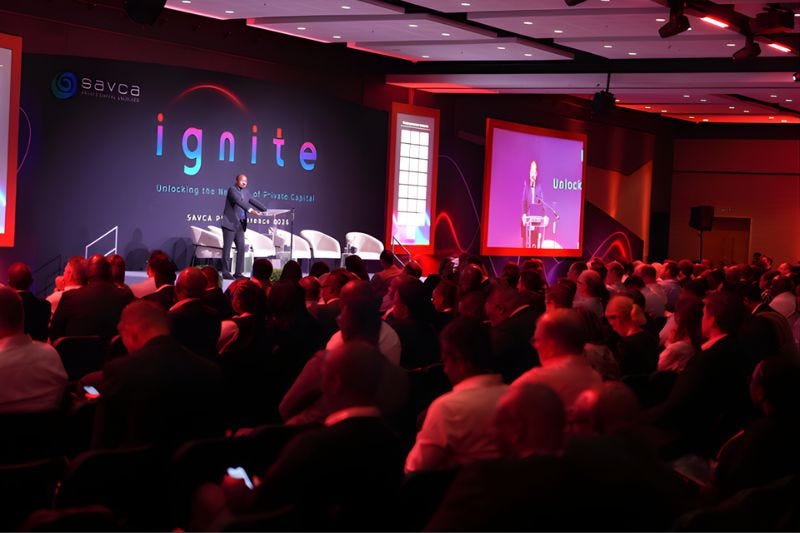
The SAVCA Private Equity Conference 2026 marked the largest gathering in the event’s history, bringing together almost 650 delegates from across the private capital ecosystem for a two-day programme on 10–11 March at the Century City Conference Centre in Cape Town.
Industry heavyweights, institutional investors, fund managers, policymakers, advisors and innovators convened for what proved to be a powerful and timely conversation about the future of private capital. With a strong and carefully curated programme anchored around the theme “IGNITE: Unlocking the Next Era of Private Capital,” the conference created a space not only for discussion, but for reflection, challenge and renewed ambition for the industry.
Across both days, the message was clear: the private capital industry stands at a moment of profound change and opportunity. Delegates arrived ready to engage, debate and explore how the sector can adapt to a shifting global landscape while continuing to unlock value, growth and impact across Southern Africa and beyond.
From the opening session, the tone was set for a conference defined by energy, candour and intellectual curiosity. Rather than treating “IGNITE” as a slogan, participants framed it as a call to action: how to spark new thinking, unlock innovation and push the boundaries of what private capital can achieve.
A sector navigating change – and opportunity
One of the defining themes across the conference was the sense that the global environment has fundamentally shifted. Political economist Ronak Gopaldas captured this mood early in the programme, arguing that the world is not merely experiencing change but entering a completely new era shaped by geopolitical rivalry, shifting trade dynamics, technological disruption and talent competition.
In this evolving landscape, Africa – and particularly Southern Africa – is increasingly central to global conversations around supply chains, resources and growth. As one of the conference’s recurring refrains suggested, Africa is simply too big to ignore.
Yet the discussions were far from abstract. Speakers and panellists repeatedly returned to the practical questions facing investors today:
How to mobilise more capital into private markets
How to structure funds and exits in a changing fundraising environment
How to unlock infrastructure investment at scale
And how to ensure the next generation of talent and leadership can sustain the industry’s growth
The result was a programme that balanced macro-level insight with real operational lessons from investors, allocators and fund managers actively deploying capital.
Vigorous debate and honest reflection
One of the most engaging moments of the conference came during a lively debate on how institutional investors should approach allocations to private capital. Should they adopt flexible, generalist strategies, or specialised allocations aligned to specific asset classes and risk profiles?
The discussion reflected a broader shift in the industry: while regulatory reforms have opened the door to larger allocations to alternatives, the real barriers often lie in education, governance processes and investor confidence.
As several speakers observed, the conversation too often centres on the perceived risks of private markets – while overlooking the opportunity cost of not investing in them.
Elsewhere, panels explored the evolving nature of fundraising and liquidity. With global private equity fundraising slowing and exits becoming more complex, managers are increasingly experimenting with evergreen structures, blended finance solutions and new alignment models between LPs and GPs.
The underlying message was clear: innovation in structure, governance and partnership will be essential to sustain growth in private markets.
Leadership, talent and the future of the industry
If the first day focused heavily on markets and capital flows, the second day turned the spotlight toward people – the talent and leadership that will ultimately shape the future of private capital.
Opening the day, leadership strategist Max Moyo challenged delegates to rethink how organisations develop and retain talent. In a powerful analogy, he suggested that leadership itself behaves like an asset class – one that has historically been mispriced and is now being repriced under pressure.
His message resonated deeply with delegates: firms may attract exceptional talent, but too often struggle to retain it. In a sector defined by high performance and competition, unpredictable leadership and weak development pipelines are not simply HR issues – they are strategic risks.
The theme of resilience and long-term thinking carried through the conference’s inspirational keynote from Olympic sprinter Akani Simbine. Reflecting on a career defined by relentless improvement and resilience in the face of repeated near misses on the global stage, Simbine reminded delegates that sustained performance comes not from sudden breakthroughs but from continuous learning, adaptation and a strong support system.
In many ways, his message mirrored the private capital journey itself: success is rarely instant, but built patiently through discipline, data, teamwork and belief in long-term value creation.
Investing for the long term
Infrastructure investment emerged as another major theme of the conference. Panellists agreed that while infrastructure remains one of Africa’s most compelling investment opportunities, the challenge lies not in a lack of capital but in a shortage of bankable, well-structured projects supported by clear regulatory frameworks and credible partners.
Stronger collaboration between the public and private sectors will therefore be essential if infrastructure investment is to move “from promise to performance.”
The conference also showcased real-world examples of private capital success stories, with fund managers sharing case studies that highlighted the discipline and foresight required to build strong exits. The lessons were consistent: exits are not engineered at the end of an investment cycle – they are designed from the beginning.
These stories illustrated the powerful role private capital can play in building globally competitive companies while delivering meaningful local impact, from job creation to skills development.
Building the next generation
Transformation and leadership development also featured prominently, highlighted by the launch of SAVCA’s new Fellowship Programme – a flagship initiative aimed at accelerating the growth of high-potential professionals within the private capital ecosystem.
The programme reflects a broader recognition that the sustainability of the industry depends not only on capital, but on developing diverse leadership pipelines capable of stewarding that capital responsibly and effectively.
IGNITING what comes next
Across two packed days of dialogue, debate and reflection, this year’s conference reinforced the vital role private capital continues to play in shaping economic growth, innovation and opportunity across the region.
The conference was marked by robust debate, shared insight and a genuine willingness to confront the industry’s toughest questions – from capital mobilisation and infrastructure investment to talent development and global competitiveness.
Most importantly, it underscored the power of the private capital community when it comes together with a shared purpose: to ignite the ideas, partnerships and investments that will define the next era of private capital.
Vote of thanks
SAVCA extends its sincere gratitude to this year’s attendees, our members, sponsors, partners, media and industry stakeholders whose participation and support made the conference possible. Without this collective commitment and engagement, an event of this scale and impact would simply not be achievable.