


** For the best experience, download the free Africa Private Equity News app Android | iOS **
By Ibrahim Sagna, executive chairman, Silverbacks Holdings
This article is slightly edited from the original published by IN THE VALLEY
For more than three decades, development finance institutions (DFIs) like IFC, BII, Proparco, and DEG acted as the anchors of African venture capital. They backed first closes, absorbed illiquidity risk, and provided the institutional confidence needed before commercial capital was willing to enter the market.
That role isn’t disappearing. But it’s no longer the defining force in the ecosystem.
In 2025, the balance of power shifted. Corporate investors became the single largest contributor to Africa-focused venture fundraising, accounting for 41% of total commitments, up from a mere 7% between 2022 and 2024.
This isn’t simply a story about new sources of capital. It’s a story about changing incentives. This article examines why the corporate cheque books are opening, why DFIs are pulling back to an extent, and how this transition is permanently reshaping the architecture of African venture capital.
The DFI retreat: A story of European bureaucracy
The slowdown in DFI participation isn’t a referendum on Africa. It’s largely a reflection of shifting institutional priorities across Europe.
Capital is being aggressively redirected toward climate finance and the energy transition. ESG mandates are now competing directly with venture allocations in emerging markets. The result? European investors, the dominant backers of African VC, accounted for just 21% of fundraising in 2025, down from 70% between 2022 and 2024.
This shift looks increasingly structural rather than cyclical.
DFIs represented 45% of Africa-focused VC commitments from 2022 to 2024. In 2025, that figure fell to 27%. For the first time since 2021, not a single Africa-focused VC fund reached a $100 million final close during the year.
Yet beneath the headline decline sits a more important development.
The retreat is offshore. Within Africa itself, conviction is strengthening. African DFIs contributed 63% of total DFI capital deployed in 2025, reversing the historical trend where international institutions dominated.
African capital is increasingly financing African innovation.
Who is writing the cheques now, and why?
Enter the corporates.
The institutions backing African VC in 2025 are not deploying philanthropic capital. These are cold, calculated, strategic allocations driven by commercial incentives, market access, and long-term positioning.
In H1 2025, corporate-backed startup funding across Africa surged 44% compared to H2 2024. A total of 26 deals closed, with aggregate funding hitting $1.4 billion. Fresh liquidity is flowing in from India, Japan, and the Middle East, particularly the UAE, Qatar, and Saudi Arabia. This isn’t tourist capital. It’s strategic capital positioning itself for long-duration exposure.
Most consequential moves, however, are happening within the continent itself:
Flour Mills of Nigeria joined a $20 million Series A round for OmniRetail, a B2B e-commerce platform deeply connected to its distribution network.
OCP Group in Morocco launched Innovx to back agtech startups tied directly to food security and agricultural infrastructure.
Alphabet quietly participated in six African deals totaling $199 million in 2025 alone.
The underlying pattern is increasingly difficult to ignore. Corporates are using VC as outsourced R&D. They are acquiring access to innovation they cannot build internally, within markets they understand and often dominate.
DFIs invested to develop the ecosystem. Corporates invest to conquer it.
When a corporate giant sits on a fund’s LP advisory board and watches a startup scale, it’s not simply monitoring quarterly performance. It’s evaluating future acquisition pathways in real time. In many cases, the exit route is already sitting inside the boardroom.
The rise of the secondaries market: Ecosystem adulthood
Globally, VC secondary deal value reached a staggering $162 billion last year.
Historically, Africa lagged behind. The market suffered from a shallow buyer pool and from DFIs unwilling to transact at discounted valuations.
That dynamic is changing rapidly.
According to the AVCA 2025 Report, secondary transactions rose from representing a quarter of financial sponsor exits (2019-2024) to half of all such exits in 2025. Financial sponsor exits hit a record high, accounting for 18% of total exit volume.
This is what a maturing ecosystem looks like.
Markets mature when they develop internal liquidity mechanisms instead of relying exclusively on IPOs or foreign trade buyers. Secondaries provide early investors with liquidity, allow founders to continue scaling without forced exits, and recycle capital back into early-stage opportunities.
As Sango Capital co-founder Richard Okello noted, the only real constraint now is ticket size. The ecosystem increasingly needs transactions large enough to attract global secondary buyers at scale. As his firm recently completed one record-breaking $120 million secondary purchase of an Africa-focused portfolio of funds, our beloved continent appears to be moving steadily toward that threshold.
The Silverbacks playbook
At Silverbacks, the secondaries market isn’t a sudden pivot. It has been part of the core thesis from the outset.
The logic is straightforward. Acquiring exposure to proven, mid- to later-stage tech enabled businesses through GP partnerships offers a structurally different risk profile from traditional early-stage deployment.
The math makes sense.
By the time these transactions occur, much of the concept and execution risk has already been absorbed. The companies possess operating histories, credible cap tables, and business models tested under real market conditions. On a single asset basis, entry risk declines. Liquidity pathways become more visible and actionable.
The results speak for themselves: LemFi (29x return), Flutterwave (24x return), Cassbana (9x return), and Moove (5.1x return).
All of these transactions were executed through GP partnerships, generating a nice series of capital gains alongside selected GPs while delivering returns to investors.
LemFi (backed by Y Combinator and Left Lane Capital) illustrates the model clearly. This was not a distressed asset. It was a well-timed entry in a cross-border payments juggernaut that continued scaling post-transaction.
New capital entered to retire early-stage money, while simultaneously introducing stronger conviction capital for the company’s next growth phase within the critical space of diaspora remittances. This is precisely the type of win-win-win scenario the secondary market is designed to create.
The shadow titan: Venture debt
The most consequential financing shift in African startups during 2025 is not happening through equity markets. It is happening through debt.
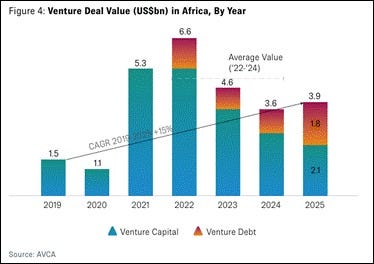
In a far more disciplined valuation environment, founders are prioritising capital efficiency over vanity metrics. Venture debt activity reflects that shift clearly: A total of 74 deals completed, up 23% YoY, while total deal value surged 91% to $1.8 billion.
Startups are extending their runway, reducing dilution, and avoiding punitive down-rounds. In this environment, debt is increasingly becoming a strategic financing instrument rather than a last-resort option.
The blind spot: What corporate money ignores
Corporate capital is efficient, but it is also selective.
It naturally gravitates toward sectors with obvious strategic synergies such as fintech, e-commerce, and logistics, particularly within the continent’s larger markets.
That creates a growing blind spot.
Frontier markets, first-time fund managers, and sectors without immediate commercial relevance risk being left behind. Historically, this was precisely the gap DFIs helped address. Their partial retreat now leaves a meaningful financing vacuum.
The long-term solution is unlikely to come from waiting for foreign DFIs to return to previous levels. The more durable answer lies in mobilising domestic institutional capital.
South Africa and Egypt are already ahead of the curve. Ghana’s 2025 mandate requiring pension funds to allocate 5% of assets to private equity and VC offers a particularly important blueprint.
Financial sovereignty ultimately requires funding domestic innovation with domestic capital.
The Federal Government of Nigeria is also preparing further innovation-oriented initiatives moving in a similar direction.
IN THE VALLEY opinion
The migration from DFI-led capital to corporate-led capital represents the most consequential structural shift in African venture capital since the 2022 boom cycle.
But the deeper story is not simply who is writing the cheques. It is how the entire machinery of the ecosystem is evolving.
Secondaries are accelerating. Venture debt is replacing highly dilutive equity. Domestic institutions are beginning to mobilise. Investors are finally prioritising liquidity, unit economics, and exit visibility over “growth-at-any-cost” narratives.
Africa’s capital ecosystem isn’t merely expanding. It’s maturing.
The capital exists. The opportunity exists. The defining winners of the next decade will be the founders and fund managers who understand the new architecture of capital, adapt to its evolving incentives, and build durable businesses capable of delivering truly consequential outcomes.
Want to know who is raising, investing, and exiting in Africa? Get Africa Private Equity News’ monthly Dealmaker’s Log – a database of reported investment deals, exits, and fundraising closes. The Dealmaker’s Log is available to all Premium subscribers, with the latest edition delivered immediately upon subscribing – subscribe now.